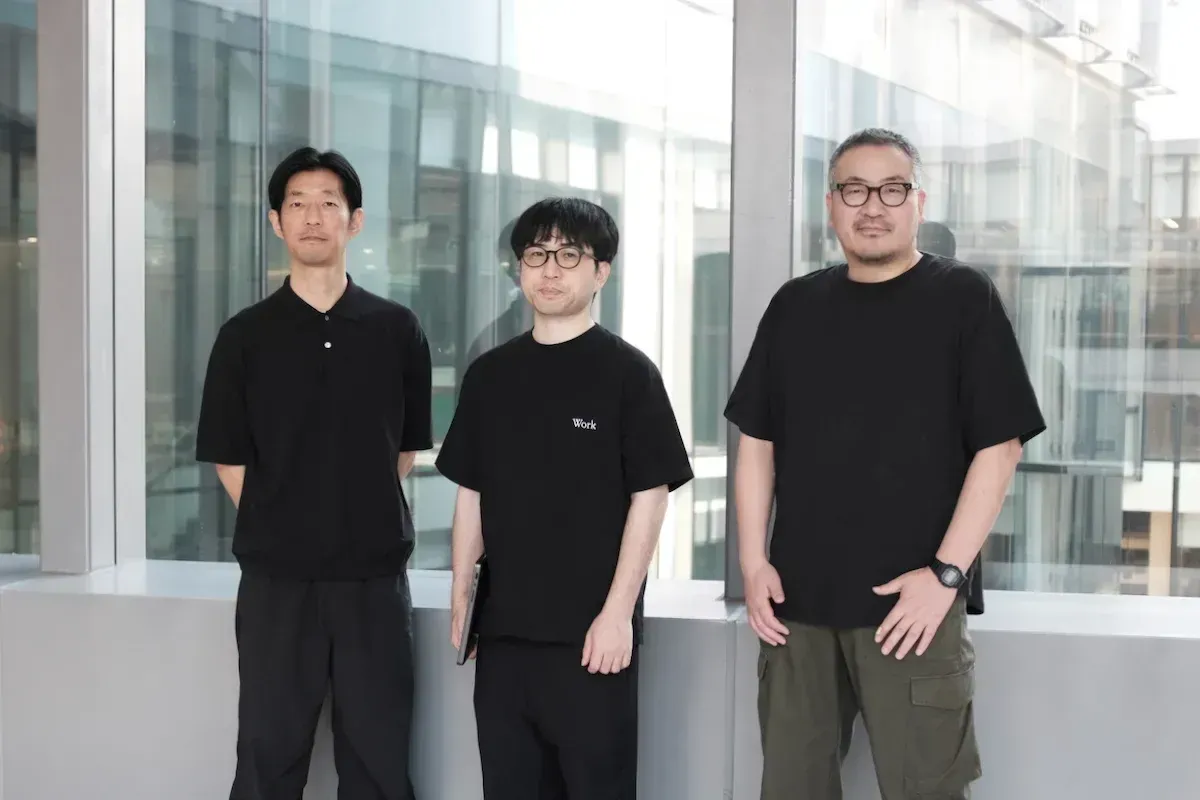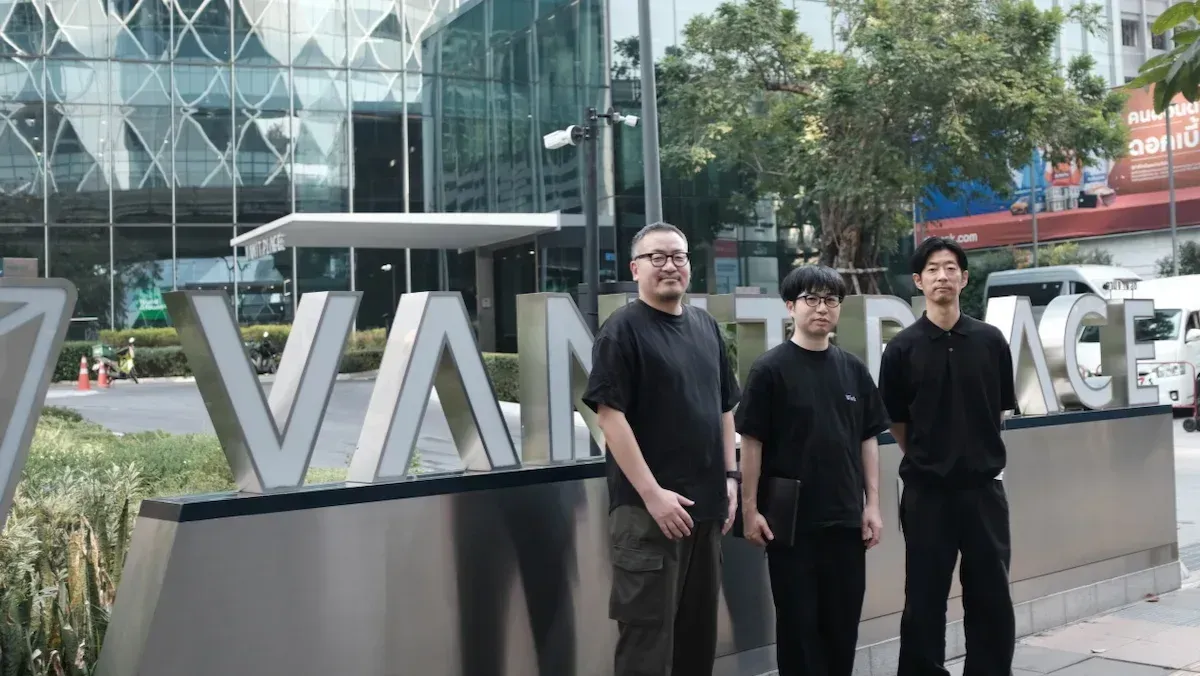
The CODING FACTORY, which builds and operates websites, is staffed by members of Monosus in Japan together with members of Monosus Thailand, the company launched in Bangkok, Thailand 13 years ago.
In October 2025, Monosus Thailand put a new management structure in place. We have been strengthening our marketing and our organization, building a structure that makes the most of Thai creativity.
We spoke with the three people who will support Monosus Thailand going forward and drive it together with its members — about how the restructuring came about, and where Monosus Thailand goes from here.
* This conversation also appears in "CF letter YOUR CODING PARTNER", the magazine published by CODING FACTORY.
The people who spoke
Yosuke Hayashi
Chief Experience Officer
After working on e-book distribution services at Dwango Co., Ltd. and MMORPG game development at Square Enix Co., Ltd., he went independent and co-founded HAUS Inc. in 2018. Centering on UI design and front-end engineering, he took on the planning and development of interactive systems such as websites and exhibition installations, and joined Monosus in 2023.
Yoshihiro Tatsuta
Chief Marketing Officer
He began his career in marketing consulting at a major independent management consulting firm, which he joined straight out of university. He joined Monosus in 2008, and has since held a series of marketing and business-leadership roles aimed at growing the company’s web business, while also handling website planning for client companies. By combining “marketing” and “web,” he drives business growth for both Monosus and its clients.
Takuya Miyagawa
Chief Operating Officer
He joined Monosus in 2009 as a short-term part-timer, then worked on coding and technical direction for website production in Yoyogi, Tokyo. In 2013 he launched Monosus Thailand in Bangkok, Thailand, and for about 12 years served as a local executive responsible for its management. He is now based in Japan again, where he serves concurrently as leader of Monosus’s back-office division and in HR-related roles.
Three months that turned into thirteen years
-- MonoThai (Monosus Thailand) is the company Miyagawa-san started 13 years ago, when he moved to Bangkok, isn’t it?
Hayashi: I’m not sure I’ve ever heard the story of those founding days in any detail.
Miyagawa: At the time I was doing coding direction at Monosus, and I also handled recruiting from time to time. One day I heard that we were going to build a production setup in partnership with a company in Thailand. While they were consulting me on how to go about it, I said I was worried we would never get a proper setup unless someone went over and really trained people on the ground — and that turned into, “Well then, go over for about three months.”
After I moved to Bangkok and was struggling to make it work, the next thing that came up was that Monosus wanted to set up a subsidiary of its own. It came down to going back to Tokyo as a web director, or becoming a local executive in Thailand. I chose whichever sounded more interesting — and before I knew it, 13 years had gone by.
Tatsuta: Back then we could not hire fast enough in Japan either, and CODING FACTORY was turning down a considerable number of projects. Other countries came up as options, but as I understand it, one of the deciding factors in setting up a company in Thailand was that Thai engineers were well placed to understand the kind of expression we were after on the front end.
Miyagawa: Living abroad had never been a dream of mine, so there were plenty of moments when I was at a loss. We would have business cards printed and the colors would come out different from what I had pictured; when we were building out the office, I ended up acting like a site foreman. Even so, I think the reason I have been able to keep going this long is that I have been lucky with the people around me — the Japanese directors and the Thai engineers alike.
A new structure born out of unease
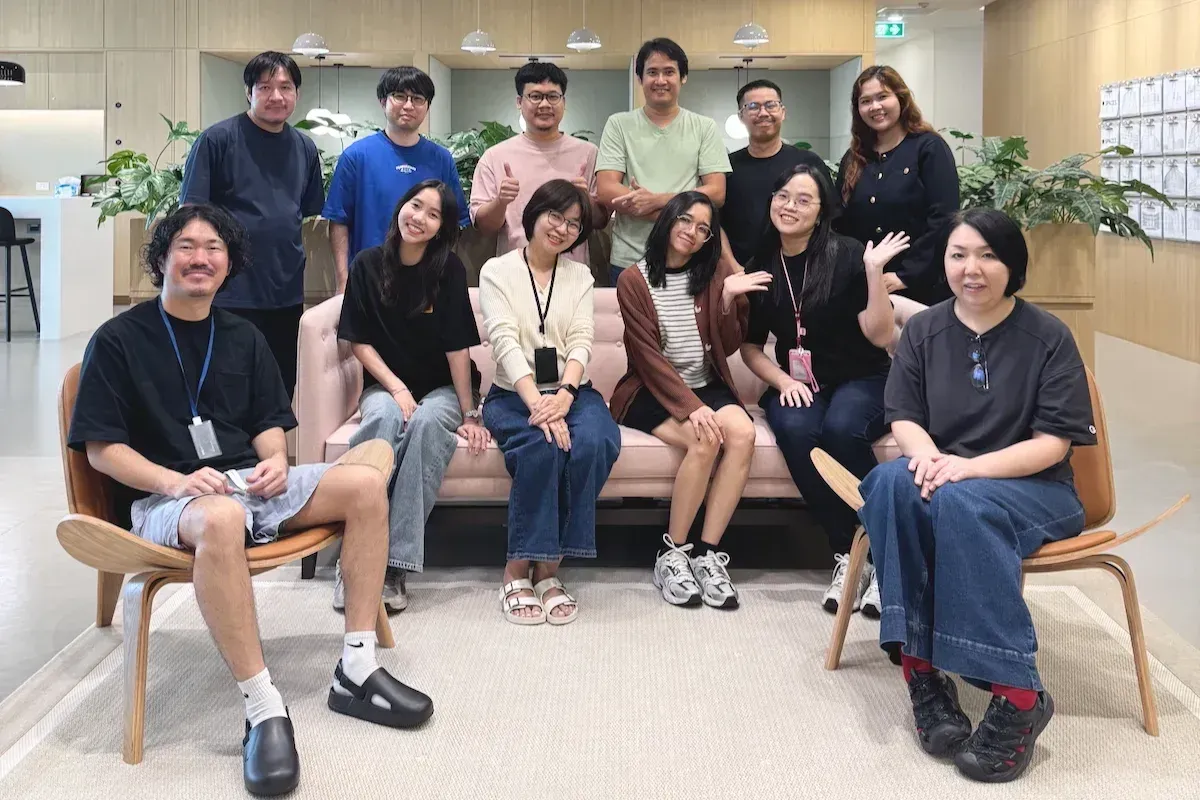
Miyagawa: The team grew little by little, and today half of CODING FACTORY’s projects are handled by our members in Thailand. Essentially, we have grown as a production base for Japanese projects coming through Monosus.
Tatsuta: Until now, what we have asked the Thai members to take on has been things like projects that involve producing uniform output at volume, and projects that express functions and designs interactively. What matters in that kind of work is understanding the instructions and the intent behind them, and keeping to them. I think a big reason we have been able to work so steadily is the Japanese directors, who connect our clients in Japan with the production members in Thailand.
Miyagawa: Some of them had been living in Bangkok already; others moved there from Japan. They all live in Bangkok, learning the language, working with the Thai members through interpreters. As the years have passed, more of them have moved to Japan and continued working on MonoThai’s projects from there.
Tatsuta: The drop in people in Bangkok overlapped a little with a period when there was less work in Thailand. At one point I had the chance to hear from one of the Japanese directors that they felt uneasy about where things were headed. That was what prompted me to start talking with Monosus’s executives about what to do with MonoThai going forward.
Miyagawa: I was still serving as an executive at MonoThai, but from around 2022 I had been spending longer stretches in Japan for family reasons. On top of that, from last year I also took on the role of leader of the head-office division that handles all of Monosus’s back-office functions. With everything going on, I had reached a point where I could not think through Thailand’s future on my own.
Tatsuta: One option that came up in those discussions was gradually scaling the business down. But Monosus’s Web & Digital Solutions simply does not work without MonoThai — it is too important to us. To keep it going, we needed to rethink MonoThai’s management approach.
Miyagawa: When the conversation turned to reviewing the structure and running it together with Yosuke (Hayashi) and Tatsuta-san, it struck me as something that could be fun. I handle building the organization. Tatsuta-san takes on marketing — creating work not only in Japan but in Thailand and across Asia. And Yosuke-san is working on broadening the range of what we do creatively, and on building an environment where the Thai engineers can take on what they want to do.
The seeds of creativity
-- Hayashi-san, you have carried on working as an engineer and designer as before, and since last year you have moved to Bangkok and started going back and forth between Japan and Thailand, haven’t you?
Hayashi: When I was brought into the Thailand side, the suggestion was that, if possible, I would live in Bangkok and engage with it properly. I had wanted to live abroad at some point anyway, and Bangkok has plenty of friends and plenty of culture I love. I had worked with MonoThai’s engineers before, and even though it was a Japanese-language site, they picked up on what we were going for and built it remarkably smoothly. That made me interested in how they work, and in their technical ability itself.
Miyagawa: You moved in November, right? I remember the Japanese directors being thrilled.
Hayashi: Working alongside them, I noticed how much they build for the enjoyment of it while trying out new technology themselves — a Japanese–Thai translation tool, a system for managing paid leave. I did not see it until I was working with them at this distance, but there is far more of a culture of getting hands-on and making things than I had imagined.
Tatsuta: Miya-chan (Miyagawa) has led the recruiting effort all this time, and I suppose this is the result — we have ended up with really good people. On top of Miya-chan, who is trusted as a manager, having Yosuke lead from the same maker’s perspective is a great combination, I think.
Hayashi: One member had a strong interest in AI and had been running study sessions, and recently that has started to move as an actual project. There is a flow now where something an individual was curious about gets put to use in real work at an organizational level. Talking with everyone, I realized how strong their drive to pursue the technology is, so I want to build an environment where they can push ahead without holding back.
What only MonoThai can do
Tatsuta: At the start of the year, all the Thai members got together and we confirmed our direction from here. The two axes are “Offshore → Valueshore” and “From Japan → To Global.” Thailand’s production quality is highly regarded, but at the moment there is still an element of us simply asking them to do what we already do in Japan. We want to grow the skills that Monosus in Japan does not have — the things only MonoThai can do.
-- What does that look like concretely?
Tatsuta: For example, the MonoThai members are better at Shopify implementation; and when it comes to converting a Japanese company’s site into a global one, the Thai members, who are comfortable in English, are stronger as well. For the large-scale sites we have handled so many of, we will put our ideas together and find ways to build them more efficiently.
Hayashi: Last October we also launched MonoThai’s own website, which has let us present what we can do properly. We have members with all kinds of skills and knowledge — people who used to develop games, people who have worked overseas. We are starting by making that visible, so people notice what we are capable of.
Miyagawa: Even just carrying on with the work we have been doing, changes are already appearing. A lot of members are glad it is becoming an environment where they can raise each other’s technical level.
Tatsuta: As work comes in not only via Japan but increasingly from Thailand and the rest of Asia, I expect we will see more projects driven mainly by the Thai members. And as the work broadens, I think we will start to see all sorts of other changes too.
Possibilities we never imagined
-- Since 2025, Monosus in Japan has been using the motto “We Co-build.” Does that connect with what is happening at MonoThai?
Hayashi: It does. When I talked about it with the members in Thailand, I had a real sense that it landed with them straight away. It is not just a client-and-vendor relationship; we build together. Not just making what we are told to make, but putting our views to each other and making it better. I think it is a phrase worth holding on to.
Miyagawa: I would like to bring in more people who feel the same way about that. There must be people in Japan and in Thailand alike who are interested in working internationally. I think it would be great for this to become a place where people with all kinds of backgrounds come together.
Hayashi: Honestly, I am seeing possibilities I never imagined back when I first got involved with MonoThai. Being able to create, ourselves, a situation where we take the initiative toward the world and feel that we might actually pull it off — that is what is interesting about a company like Monosus.
Tatsuta: That is where I feel Monosus’s strength lies. You get to take on challenges you could not take on alone. If you try something and it does not work, you think up the next approach. In Thailand too, once the web side is on firmer ground, maybe the Food Solutions members open a restaurant — in a few years, something we cannot even imagine now might be getting started.
Miyagawa: I hope that with Yosuke-san’s connections and creativity meeting Tatsuta-san’s marketing strength, we can become an interesting company in Thailand and across Asia. The conditions for that are in place now, so I am looking forward to MonoThai’s future myself.
Monosus Thailand
https://www.monosusthailand.com/
Monosus Thailand is looking for people to work with us.
See here for details.
Wantedly